
Ansys Electronics provides an integrated suite of tools that empower engineers to design, simulate, and optimize electronic and electromagnetic systems across frequencies and power levels. From chip to system, engineers can predict behavior, validate performance, and ensure compliance — long before hardware testing.
Core Products






Electronic Desktop – Complete Electronics Simulation Environment
Centralized platform for managing and executing all electronics design and simulation workflows.
Electronic Desktop is a unified environment that brings together multiple Ansys electronics simulation tools, allowing engineers to design, analyze, and validate electronic circuits, PCB layouts, and systems efficiently. It provides a single interface to access specialized tools for filter design, circuit synthesis, electromagnetic analysis, and compliance testing, streamlining workflows and reducing the need for multiple software platforms
Used for:
PCB designers, circuit engineers, RF/microwave engineers, and electronics system developers.
Key Benefit:
Simplifies electronics simulation by integrating all tools in one platform, enabling faster design iterations, accurate analysis, and improved collaboration across engineering teams.

Nuhertz FilterSolutions – Advanced Filter Design
Design precise RF and microwave filters with automated synthesis and optimization.
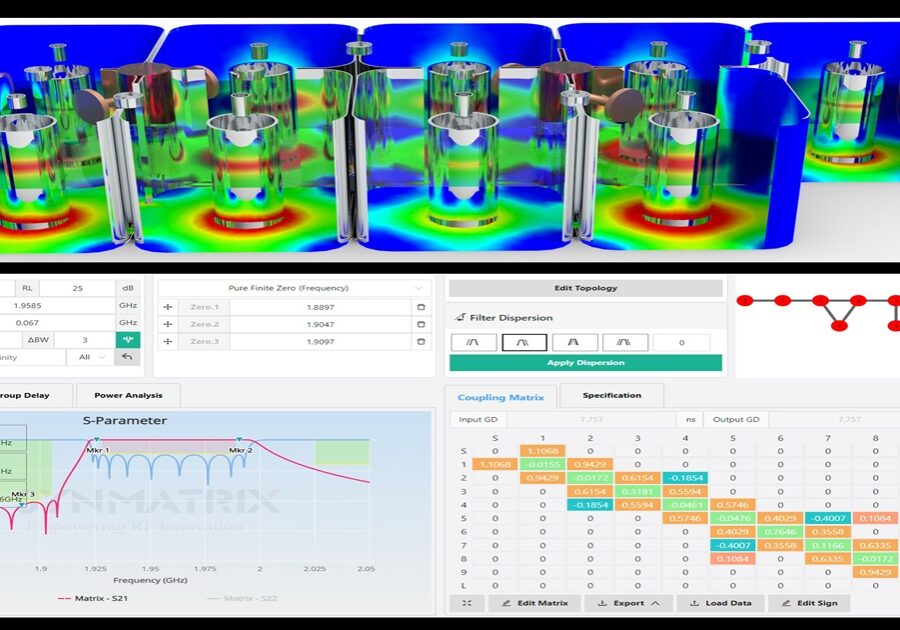
Nuhertz FilterSolutions allows engineers to create lumped, distributed, and coupled-resonator filters with ease. It provides automated topology synthesis, tuning, and performance optimization, ensuring designs meet target specifications for insertion loss, return loss, and bandwidth.
Used for:
RF/microwave filter designers, communication system engineers.
Key Benefit:
Accelerates filter design cycles and ensures high-performance, ready-to-manufacture solutions without extensive manual calculations.

SynMatrix – Synthesize and Optimize Circuits
Rapidly synthesize and optimize linear, RF, and microwave circuits for high-performance designs.
SynMatrix enables engineers to generate circuit schematics from filter specifications, simulate performance, and optimize component values automatically. It supports active, passive, and distributed networks, helping teams iterate quickly and validate designs against performance targets.
Used for:
Circuit designers, RF and analog engineers, communication system developers.
Key Benefit:
Reduces design time and ensures accurate, performance-optimized circuits ready for prototyping and production.
Charge Plus – Electrostatic and Charge Analysis
Analyze and predict electrostatic effects and charge distribution in complex electronic systems.
Charge Plus allows engineers to model charge accumulation, electrostatic discharge (ESD) risks, and voltage distributions across PCB layouts and assemblies. It helps identify potential hazards and optimize grounding and shielding strategies to prevent component damage.
Used for:
Electronics designers, PCB engineers, high-voltage system developers.
Key Benefit:
Enhances device safety and reliability by predicting and mitigating electrostatic issues before physical testing.

EMC Plus – Electromagnetic Compatibility & Interference Analysis
Ensure EMC compliance and minimize interference in electronic devices.
EMC Plus enables engineers to simulate radiated and conducted emissions, susceptibility, and immunity under real-world operating conditions. It supports regulatory compliance testing and helps design electronics that operate reliably in complex electromagnetic environments.
Used for:
PCB designers, system integrators, RF engineers, and compliance teams.
Key Benefits:
Reduces costly redesigns, ensures regulatory compliance, and improves overall system performance in electromagnetic environments.

Highlights of Electronics Simulation
Electromagnetic Field Simulation
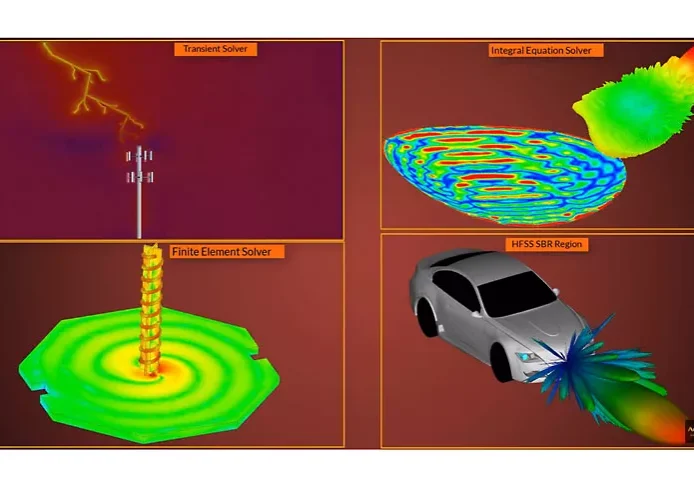
Predict and analyze electric and magnetic field behavior in both 2D and 3D with high precision, enabling accurate design of motors, transformers, actuators, and sensors.
Key Capabilities
Benefits

High-Frequency & Antenna Design
Design and optimize antennas, waveguides, and RF/microwave components for superior signal performance.
Key Capabilities
Benefits
Signal & Power Integrity
Ensure reliable high-speed data transfer and stable power distribution across PCBs and complex electronic networks.
Key Capabilities
Benefits

Electronics Cooling & Thermal Management
Analyze heat dissipation and thermal behavior to protect sensitive components from overheating.
Key Capabilities
Benefits

PCB & Package-Level Analysis
Simulate performance of boards and IC packages to ensure reliability under electrical, thermal, and mechanical stresses.
Key Capabilities
Benefits

Electrostatic & Dielectric Analysis
Ensure safety and efficiency of high-voltage devices, insulators, capacitors, and power electronics.
Key Capabilities
Benefits

Electronic Component Lifetime & Reliability
Predict failure modes caused by thermal, mechanical, or electrical stresses to increase product longevity.
Key Capabilities
Benefits

EMC & EMI Analysis
Analyze and control unwanted electromagnetic emissions and ensure immunity to external interference.
Key Capabilities
Benefits

Applications across Industries
Ansys Electronics solutions empower innovation across multiple sectors —
Automotive, Aerospace, Telecommunications, Consumer Electronics, and Industrial Equipment — ensuring system reliability, thermal safety, and electromagnetic performance.
Relevant FAQs
Yes, Ansys Maxwell handles low-frequency designs, while HFSS manages high-frequency and RF systems.
Yes, SIwave provides complete PDN, crosstalk, and EMI/EMC evaluation for PCB designs.
Yes, Ansys Icepak offers advanced thermal-fluid simulation to predict component and board temperatures.
Yes, electrical, thermal, and structural simulations can be fully coupled for real-world system validation.
Yes, Maxwell enables parametric studies and design optimization for electromechanical systems.
Success Stories
Ready to power your designs with Ansys Electronics?
Get licensing, pricing, and training support from SolidTrust Technologies, your trusted Ansys partner in South India.

