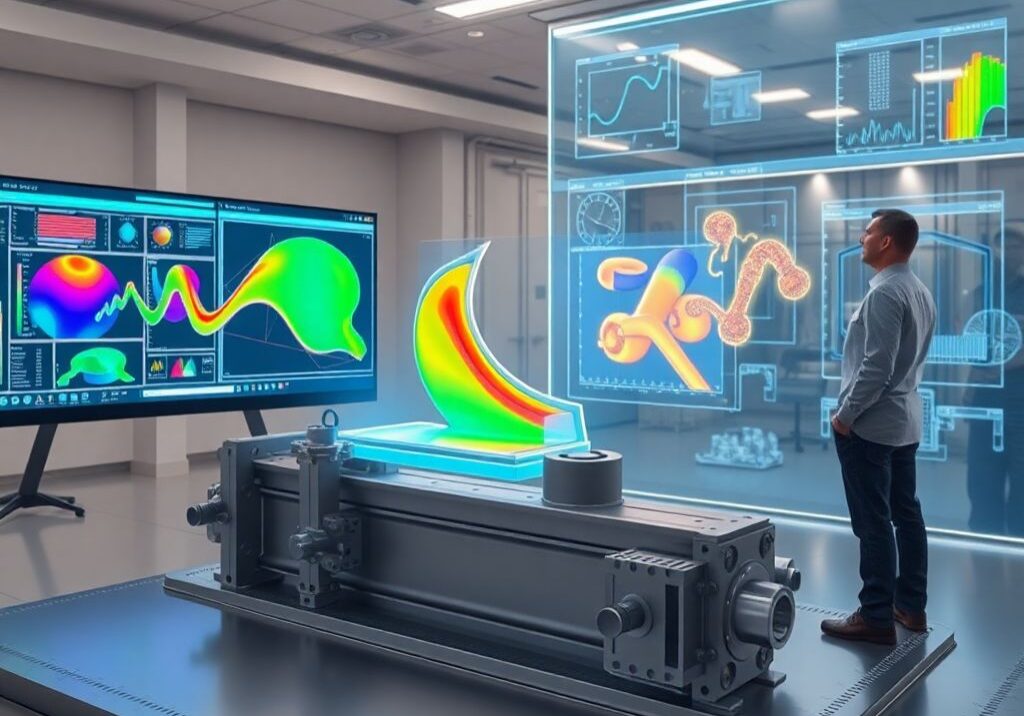
HFSS is a full-wave 3D EM simulation tool that solves Maxwell’s equations using finite element analysis. It enables detailed modeling of electromagnetic interactions in complex structures, including PCB traces, connectors, waveguides, and antennas. Its automated adaptive meshing and solver technology ensures accurate results, reducing design cycles and physical prototyping costs.
What’s in it for Engineers
Advanced Electromagnetic Simulation:
HFSS specializes in high-frequency electromagnetic simulations, making it perfect for engineers designing antennas, radars, and RF components. It ensures that electromagnetic behavior is accurately captured for wireless communication and radar systems.
Signal Integrity and EMI/EMC Compliance:
Engineers can predict and mitigate electromagnetic interference (EMI) and electromagnetic compatibility (EMC), which are critical for ensuring that consumer and industrial electronics meet stringent regulatory standards.
3D Full-Wave Electromagnetic Simulation:
HFSS offers the capability to simulate complex, 3D electromagnetic fields, helping engineers design miniaturized communication devices that are both efficient and effective.

Featured Applications
Ansys HFSS is a leading simulation tool for electromagnetic field analysis, widely used in applications involving high-frequency components and systems. Here are the key applications:
Antenna Design

Wireless Communication

Automotive

Aerospace & Defense

Consumer Electronics

Medical Devices

Power Electronics & Energy

High-Speed Electronics & PCB Design

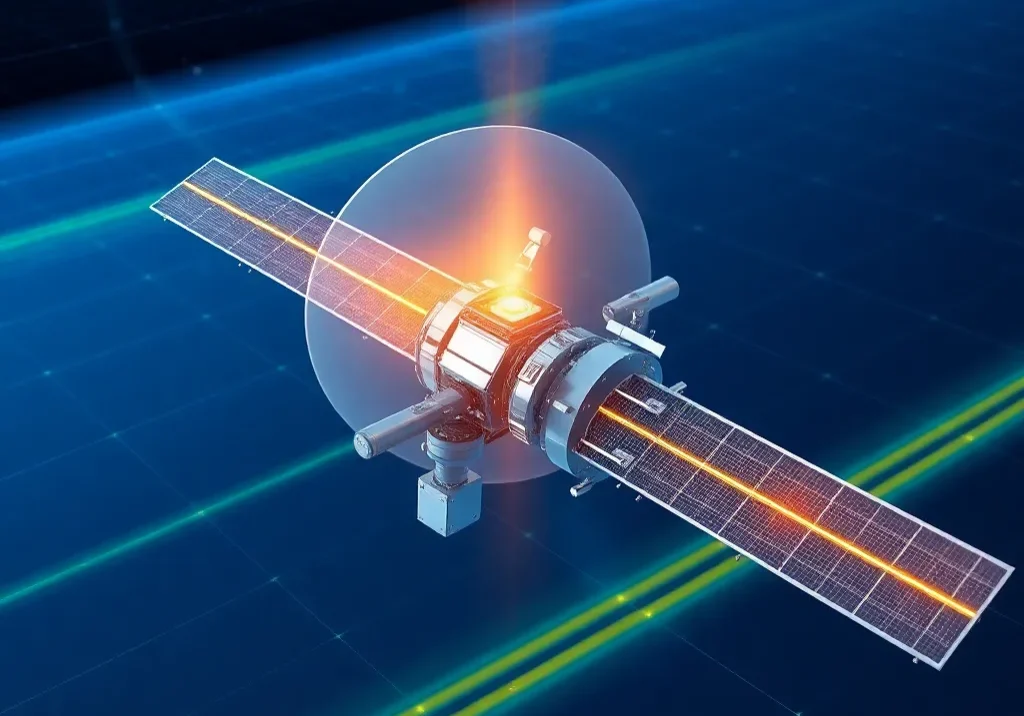
Communication Satellites
Semiconductor Design

Terahertz and Photonics

Relevant FAQs
Yes, HFSS specializes in 3D full-wave electromagnetic simulation for high-frequency designs.
Yes, it is widely used for designing and optimizing antennas, from basic to complex arrays.
Yes, it can predict and mitigate EMI for components such as PCBs and ICs.
It provides high-fidelity simulations to ensure signal integrity in high-speed circuits and systems.
Yes, it supports a wide range of material models, including dielectric and conductive materials.
It calculates radiation patterns, helping engineers design efficient, low-interference antennas.
Yes, it is ideal for simulating radar components and optimizing performance in RF systems.
Telecommunications, automotive, aerospace, consumer electronics, and industrial electronics.
Yes. HFSS can be coupled with multiphysics simulations for thermal and structural effects.
RF engineers, antenna designers, electronics designers, and R&D teams working on high-frequency electronics.
Ready to unlock the full potential of Ansys HFSS?
Unlock high-performance electromagnetic simulations with Ansys HFSS for antennas, waveguides, and complex 3D designs.