Ansys Lumerical

Unlock Photonic Innovation

Simulation Platform for Photonic and Optoelectronic Devices

Ansys Lumerical provides advanced multiphysics simulation for designing photonic components and integrated circuits. It allows engineers to explore light–matter interactions at the nanoscale for next-generation optical technologies.

With solvers for FDTD, MODE, CHARGE, and DEVICE, Lumerical enables accurate modeling of waveguides, lasers, modulators, and photonic ICs. It is essential for telecommunications, semiconductor, and quantum photonics research, driving innovation in high-speed and energy-efficient optical systems.

What's in it for Engineers

Photonic Design and Optimization: Lumerical enables engineers to simulate and optimize photonic devices, including waveguides, lasers, and modulators, with high accuracy for applications in optical communication, quantum computing, and semiconductor manufacturing.

Fast and Accurate Simulations: Lumerical offers advanced simulation capabilities for both time-domain and frequency-domain analyses, allowing engineers to achieve fast and accurate results for complex optical and photonic systems.

Integrated Multi-Physics: Engineers can integrate electromagnetic, thermal, and mechanical simulations to understand how devices will behave under real-world operating conditions, ensuring high performance and reliability in production.

Design for Fabrication: With Lumerical’s ability to simulate fabrication processes, engineers can ensure that their designs are not only optimized for performance but also feasible for cost-effective manufacturing with fewer iterations.
2025_12_05_05_40_26_062_508613

Featured Applications

Ansys Lumerical is a suite of photonic design tools that enable the simulation and optimization of light-based systems. It is used in applications such as integrated photonics, optoelectronics, and nanophotonics. 

Integrated Photonics Design
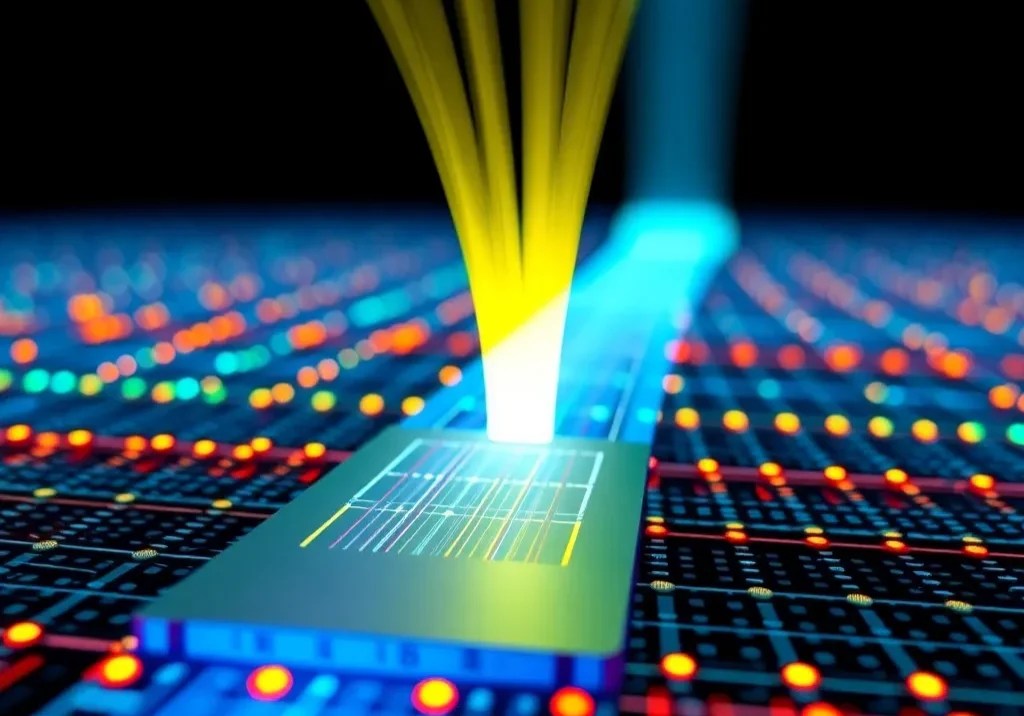
Waveguide Design: Design and optimize photonic waveguides for efficient light propagation in integrated circuits.

Optical Interconnects: Simulate optical interconnects between integrated photonic devices to ensure fast, reliable data transmission.

On-Chip Photonics: Model and optimize on-chip photonic devices like modulators, switches, and multiplexers for integrated systems.

2025_12_05_05_42_29_957_488995

Photonic Crystal Structures

Band Gap Engineering: Design photonic crystals to manipulate light by creating band gaps for specific wavelengths.

Defect Creation: Simulate the creation and manipulation of defects in photonic crystals for novel devices like sensors and filters.

Light Trapping: Optimize structures for enhanced light trapping and guiding, improving device efficiency.

2025_12_05_05_43_56_506_577863

Plasmonics and Metamaterials

Surface Plasmon Resonance: Model surface plasmonic interactions for applications in sensors, imaging, and nanophotonics.

Metamaterials Design: Design optical metamaterials that exhibit unique properties not found in natural materials, such as negative refraction.

Enhanced Light-Matter Interaction: Simulate and optimize devices that exploit strong light-matter interactions for high sensitivity and resolution.

2025_12_05_05_45_31_260_204555

Optical Communication Systems

Modulator Design: Design and optimize modulators for high-speed optical communication systems.

Photodetectors: Simulate the behavior of photodetectors for high-performance signal reception in optical communication systems.

Interference and Crosstalk Analysis: Analyze and mitigate interference and crosstalk in optical communication components.

2025_12_05_05_50_48_599_724607

Nano-Optics and Nanophotonics

Nanostructure Design: Simulate nanophotonic devices like nano-antennas and resonators that operate at the nanoscale.

Light Concentration: Design nanostructures that concentrate light to enhance performance in sensing and imaging applications.

Optical Force and Field Manipulation: Model the manipulation of optical fields at the nanoscale for applications like biosensing and energy harvesting.

2025_12_05_05_52_18_670_160836

Semiconductor Optoelectronics

Laser Diodes: Design and optimize semiconductor laser diodes for high-efficiency light emission in optical devices.

Photonic Devices: Simulate the behavior of photonic devices like modulators, detectors, and switches in optoelectronic systems.

Quantum Dots and Nanowires: Model the behavior of quantum dots and nanowires in optoelectronic devices for advanced applications.

2025_12_05_05_54_05_519_345047

Metrology and Sensing

Sensor Design: Develop high-performance optical sensors based on photonic and plasmonic principles for chemical, biological, and environmental sensing.

Spectroscopy: Simulate optical systems for spectroscopy applications, enhancing sensitivity and accuracy.

Interferometry: Design and optimize interferometric systems for precise measurement of physical quantities like displacement, strain, and temperature.

2025_12_05_05_58_32_215_680457

Solar Cells and Energy Harvesting

Photovoltaic Design: Optimize solar cell designs to maximize efficiency by simulating light absorption and charge transport in materials.

Light Trapping in Solar Cells: Simulate and optimize light trapping techniques to improve solar cell performance.

Energy Harvesting Devices: Design photonic devices for harvesting light from ambient sources, enhancing energy efficiency.

2025_12_05_05_58_32_215_680457

Quantum Photonics

Quantum Computing: Design and simulate quantum photonic devices for use in quantum computing and information processing.

Entangled Photon Generation: Model and optimize the generation of entangled photons for quantum communications and cryptography.

Quantum Light Sources: Simulate the behavior of quantum light sources like single-photon emitters for secure communication and sensing.

2025_12_05_06_01_35_686_653316

Biomedical Optics

Biosensing: Design photonic sensors for detecting biological markers, enabling non-invasive medical diagnostics.

Imaging Systems: Simulate and optimize optical systems for high-resolution biomedical imaging, such as microscopy and endoscopy.

Laser Treatment Systems: Model and optimize laser systems used for medical applications like cancer treatment, skin therapy, and surgery.

2025_12_05_06_03_30_581_515603

Relevant FAQs 

Can Lumerical simulate photonic devices? +

Yes, Lumerical specializes in simulating photonic devices, including waveguides, resonators, and modulators.

Does Lumerical support simulations for quantum devices? +

Yes, it supports quantum optical simulations for cutting-edge quantum computing and communication applications.

How does Lumerical handle material characterization? +

It provides accurate material modeling, including dispersion and nonlinear properties for photonic simulations.

Can Lumerical model light-matter interactions? +

Yes, it models light-matter interactions for designing optical components and systems.

Does Lumerical integrate with other Ansys simulation tools? +

Yes, it integrates with Ansys tools like HFSS for enhanced electromagnetic and multiphysics simulations.

Can Lumerical simulate integrated photonic circuits? +

Yes, it simulates integrated photonic circuits for applications in telecommunications and data transmission.

How does Lumerical assist in designing optoelectronic devices? +

It provides powerful tools to design and optimize optoelectronic devices, including lasers and detectors.

Ready to unlock the full potential of Ansys Lumerical?

Get a closer look at Ansys Lumerical for optical design and simulation, offering unparalleled performance in light-ray tracing.
2025_12_30_12_41_27_256_299933
We’re Online! How may I help you today?