
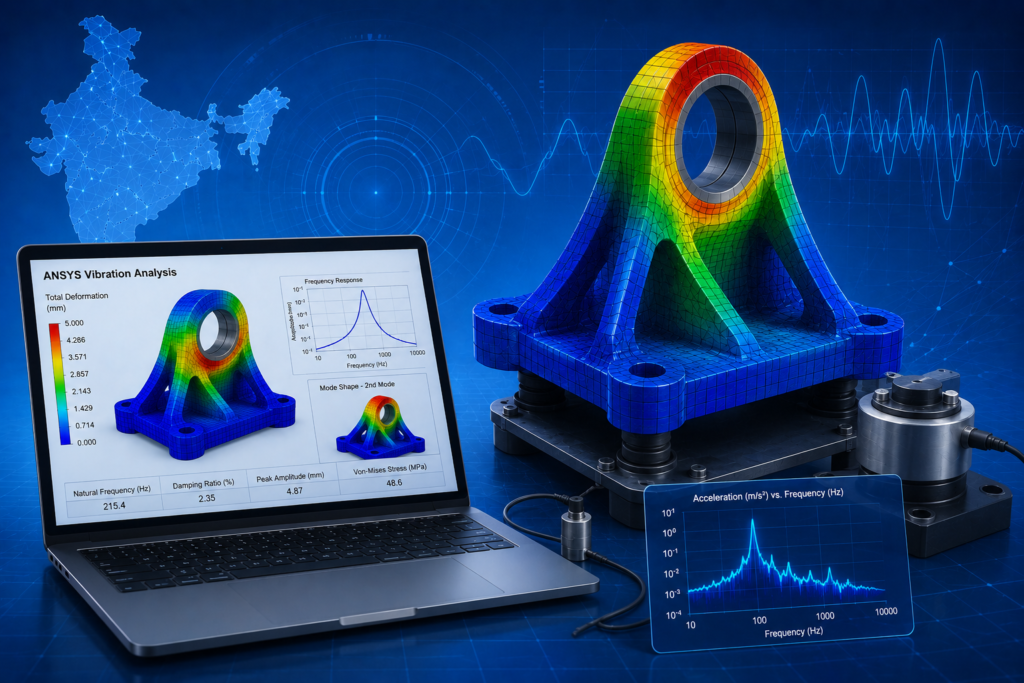
ANSYS Vibration Analysis Services | SolidTrust
ANSYS Vibration Analysis
Advanced ANSYS Vibration Analysis Services for Structural and Dynamic Engineering Simulations
At Solid Trust, we provide professional ANSYS Vibration Analysis services to help manufacturers, OEMs, engineering companies, and research organizations evaluate structural vibration, dynamic behavior, resonance, and product reliability. Using advanced ANSYS simulation solutions, our engineers analyze how components and structures respond to dynamic loads, operating conditions, and vibration environments before manufacturing.
Our simulation-driven engineering approach helps organizations identify vibration-related design risks, improve structural performance, reduce prototype testing, and accelerate product development through accurate virtual analysis.
Why Choose Solid Trust?
- Experienced ANSYS Simulation Experts
- Extensive Engineering Analysis Experience
- Advanced Vibration Simulation
- Modal and Dynamic Analysis
- Accurate Simulation Results
- Reduced Prototype Testing
- Faster Product Development
- Detailed Engineering Reports
- Industry-Specific Solutions
- Confidential Project Handling
- Quick Turnaround Time
Our ANSYS Vibration Analysis Services
Modal Analysis
Identify the natural frequencies and mode shapes of structures and components to understand their dynamic behavior.
Applications include:
- Automotive Components
- Industrial Machinery
- Aerospace Structures
- Mechanical Assemblies
- Rotating Equipment
- Structural Components
Benefits include:
- Identification of Natural Frequencies
- Improved Structural Design
- Reduced Resonance Risk
- Better Dynamic Performance
- Increased Product Reliability
Harmonic Response Analysis
Evaluate how structures respond to sinusoidal or periodic excitation over a specific frequency range.
Suitable for:
- Rotating Machinery
- Pumps
- Motors
- Fans
- Compressors
- Industrial Equipment
- Automotive Systems
Simulation capabilities include:
- Displacement Response
- Stress Response
- Frequency Response
- Resonance Identification
- Dynamic Load Evaluation
Random Vibration Analysis
Analyze structural response to random vibration environments experienced during transportation, operation, and service conditions.
Applications include:
- Aerospace Equipment
- Automotive Systems
- Electronics
- Industrial Machinery
- Transportation Equipment
- Defense Systems
Analysis can evaluate:
- Random Vibration Response
- Power Spectral Density
- Stress Distribution
- Displacement Response
- Fatigue Risk
Transient Dynamic Analysis
Evaluate structural response to time-dependent loads, shocks, impacts, and rapidly changing operating conditions.
Applications include:
- Mechanical Systems
- Automotive Components
- Industrial Equipment
- Machinery
- Structural Assemblies
- Impact-Loaded Components
Simulation includes:
- Time-Based Structural Response
- Dynamic Stress
- Displacement
- Acceleration
- Impact Response
- Transient Loading
Vibration Fatigue Analysis
Evaluate the potential for fatigue damage caused by repeated vibration and dynamic loading.
Suitable for:
- Automotive Components
- Industrial Machinery
- Aerospace Components
- Rotating Equipment
- Mechanical Assemblies
- Structural Systems
Benefits include:
- Improved Fatigue Life
- Identification of Critical Locations
- Reduced Failure Risk
- Improved Component Reliability
- Optimized Structural Designs
Frequency Response Analysis
Analyze how structures respond across different operating frequencies to identify critical vibration zones and resonance conditions.
Simulation capabilities include:
- Frequency Response
- Dynamic Stress
- Displacement
- Acceleration
- Resonance Detection
- Structural Response Evaluation
Resonance Analysis
Identify potential resonance conditions where operating frequencies may approach the natural frequencies of a structure.
Our engineers evaluate:
- Natural Frequencies
- Operating Frequencies
- Mode Shapes
- Dynamic Response
- Resonance Risk
- Structural Stability
Resonance analysis helps prevent excessive vibration, noise, fatigue, and premature component failure.
Industries We Serve
Our ANSYS Vibration Analysis services support engineering projects across multiple industries, including:
- Automotive
- Aerospace
- Manufacturing
- Industrial Equipment
- Heavy Machinery
- Renewable Energy
- Oil & Gas
- Power Generation
- Electronics
- Robotics
- Transportation
- Defense
- Research & Development
Benefits of ANSYS Vibration Analysis
Vibration simulation provides engineers with a detailed understanding of how products and structures behave under dynamic operating conditions.
Key benefits include:
- Improved Structural Performance
- Reduced Resonance Risk
- Better Product Reliability
- Increased Component Life
- Reduced Prototype Costs
- Faster Product Development
- Improved Design Accuracy
- Reduced Engineering Risks
- Optimized Product Performance
- Better Fatigue Resistance
Why Choose ANSYS for Vibration Analysis?
ANSYS provides advanced engineering simulation capabilities for evaluating structural dynamics and vibration behavior. Engineers can investigate complex dynamic conditions virtually and make informed design decisions before physical testing and manufacturing.
With ANSYS vibration simulation, organizations can:
- Identify Critical Frequencies
- Evaluate Dynamic Structural Behavior
- Detect Resonance Conditions
- Improve Product Reliability
- Optimize Structural Designs
- Reduce Physical Prototype Testing
- Validate Engineering Designs
- Improve Product Performance
Our Engineering Workflow
Step 1 – Requirement Analysis
Understand project objectives, operating conditions, vibration sources, loading conditions, materials, and required simulation outcomes.
Step 2 – CAD Model Preparation
Import and prepare CAD geometry for vibration and structural dynamic simulations.
Step 3 – Material and Boundary Condition Setup
Define material properties, supports, contacts, loads, excitation conditions, and other required simulation parameters.
Step 4 – Vibration Simulation
Perform modal, harmonic response, random vibration, transient dynamic, or frequency response analysis using ANSYS.
Step 5 – Results Evaluation
Analyze natural frequencies, mode shapes, stress, displacement, acceleration, frequency response, and other important simulation results.
Step 6 – Design Optimization
Recommend engineering improvements to reduce vibration, avoid resonance, improve structural performance, and increase product reliability.
Step 7 – Final Engineering Report
Deliver detailed reports containing simulation results, contour plots, graphs, mode shapes, frequency response results, engineering observations, and recommendations.
Why Companies Trust Solid Trust
Solid Trust combines engineering expertise with advanced ANSYS simulation technologies to solve complex vibration and structural dynamics challenges. Our ANSYS Vibration Analysis services help organizations identify potential failures, improve product reliability, optimize designs, and reduce development risks through advanced virtual simulation.
Whether you need a single vibration simulation or ongoing engineering analysis support, our experts provide reliable and cost-effective ANSYS solutions tailored to your project requirements.
Frequently Asked Questions
What is ANSYS Vibration Analysis?
ANSYS Vibration Analysis is a simulation-based engineering approach used to evaluate how structures and components respond to dynamic loads, vibration, frequency excitation, and operating conditions.
What types of vibration analysis can Solid Trust perform?
Solid Trust can support modal analysis, harmonic response analysis, random vibration analysis, transient dynamic analysis, frequency response analysis, resonance assessment, and vibration fatigue analysis.
Can ANSYS identify resonance problems?
Yes. Modal and frequency-based simulations can help identify natural frequencies and determine whether operating conditions may create resonance risks.
Which industries benefit from ANSYS Vibration Analysis?
Automotive, aerospace, manufacturing, industrial equipment, heavy machinery, energy, electronics, robotics, transportation, defense, and research organizations can benefit from vibration simulation.
Can vibration analysis reduce product development costs?
Yes. Virtual vibration analysis can help identify design problems before physical prototypes and testing, reducing design iterations and development costs.
How long does an ANSYS Vibration Analysis project take?
Project duration depends on geometry, simulation complexity, loading conditions, analysis type, and reporting requirements. Projects can range from a few days to several weeks.
Contact Us
Looking for Expert ANSYS Vibration Analysis Services?
Partner with Solid Trust to evaluate structural vibration, dynamic response, resonance, and product reliability using advanced ANSYS simulation solutions.
