
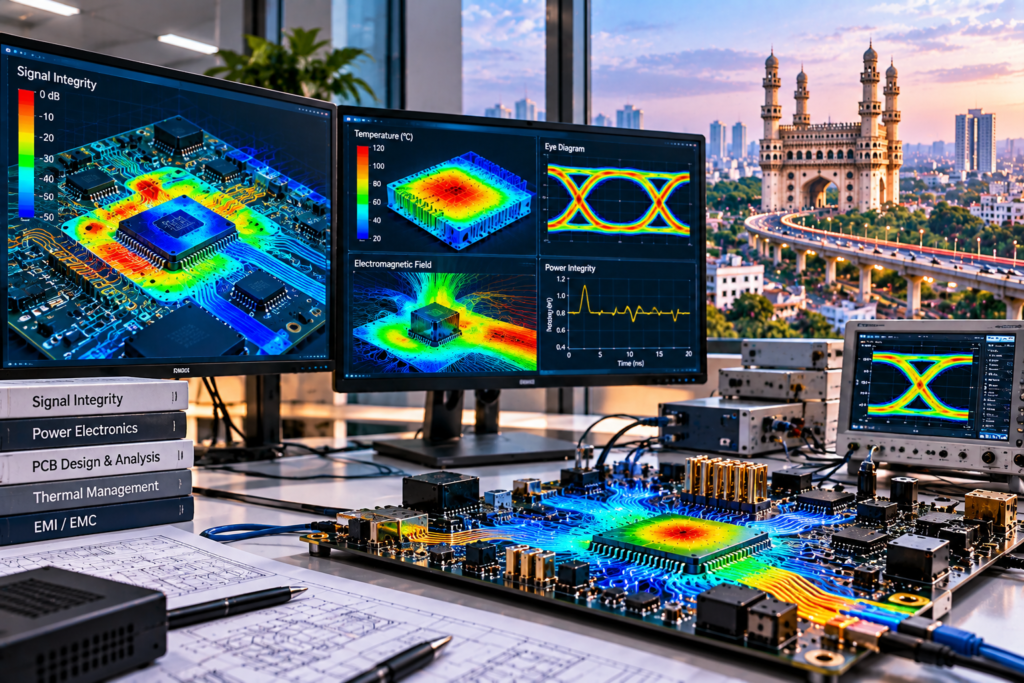
Electronics Simulation Hyderabad: Advanced Engineering Analysis Solutions
Electronics Simulation Hyderabad: Advanced Engineering Analysis Solutions Electronic products are becoming smaller, faster, and more complex. As a result, engineering teams must address challenges involving signal quality, electromagnetic interference, power efficiency, and thermal performance. Simulation helps engineers investigate these challenges before building physical prototypes.
Electronics simulation Hyderabad services can support companies developing electronic systems, printed circuit boards, power electronics, and high-performance products. SolidTrust Technologies provides engineering simulation support to help businesses evaluate design performance and investigate potential technical issues.
What Is Electronics Simulation?
Electronics simulation uses computational tools to study the electrical, electromagnetic, and thermal behaviour of electronic components and systems. Engineers can evaluate design alternatives and identify potential performance concerns during product development.
Depending on the application, electronics simulation may involve circuit analysis, electromagnetic field simulation, signal integrity, power integrity, and thermal analysis.
With electronics simulation, engineering teams can investigate:
- Signal integrity and high-speed PCB performance
- Power integrity and power distribution networks
- Electromagnetic interference and compatibility
- Electronic component heating and cooling
- Power electronics and switching systems
- Antenna performance and electromagnetic fields
- Electrical behaviour under different operating conditions
The appropriate simulation approach depends on the product architecture, operating frequency, materials, and design requirements.
Electronics Simulation Hyderabad for Modern Product Development
Companies developing electronic products need to consider electrical, electromagnetic, and thermal performance together. A design that meets one requirement may still experience problems under different operating conditions.
Electronics simulation helps engineering teams evaluate these factors systematically. It can also support design comparisons before committing to physical prototypes and laboratory testing.
1. Signal Integrity Analysis
Signal integrity is essential for high-speed digital systems. Poor signal quality can contribute to timing errors, reflections, crosstalk, and communication failures.
Signal integrity analysis helps engineers investigate how signals travel through PCB traces, connectors, and interconnects. It can reveal impedance discontinuities and other potential issues that affect high-speed performance.
Typical applications include high-speed PCBs, communication equipment, embedded systems, and advanced electronic assemblies.
2. Power Integrity Analysis
Power integrity analysis evaluates the stability and quality of power delivered to electronic components. Voltage fluctuations and excessive noise can affect system performance.
Engineers can use power integrity studies to investigate power distribution networks, decoupling strategies, voltage drop, and current distribution.
These studies are useful for complex PCBs, processors, networking equipment, and other electronic systems with demanding power requirements.
3. Electromagnetic Simulation
Electromagnetic simulation helps engineers understand electromagnetic fields and their interaction with components, conductors, and surrounding structures.
Depending on the design, analysis can support antenna development, electromagnetic coupling studies, interference investigation, and shielding assessment.
This approach can help identify potential electromagnetic issues during the design stage. Physical measurements may still be required to verify final product performance and compliance.
4. Power Electronics Simulation
Power electronics systems are used in motor drives, converters, inverters, renewable energy systems, and electric vehicles.
Simulation can help engineers investigate switching behaviour, electrical losses, electromagnetic effects, and thermal performance. The analysis method depends on the circuit topology and the level of detail required.
By evaluating design alternatives, engineering teams can investigate opportunities to improve efficiency, reliability, and operating performance.
5. Electronics Thermal Simulation
Electronic components generate heat during operation. If heat is not managed effectively, excessive temperatures may affect performance and component reliability.
Thermal simulation helps engineers evaluate temperature distribution, heat transfer, and cooling effectiveness. It can support the assessment of heat sinks, airflow paths, component placement, and thermal interfaces.
These studies are especially useful for compact electronic enclosures, high-power devices, and systems operating under demanding environmental conditions.
6. PCB and Electromagnetic Compatibility Analysis
Printed circuit board design can influence signal quality, power distribution, and electromagnetic behaviour.
Simulation can help engineers investigate coupling between circuit elements, electromagnetic emissions, and susceptibility to external interference. Depending on the design, engineers may also evaluate grounding, shielding, and layout alternatives.
Simulation results can guide design improvements before physical electromagnetic compatibility testing.
Industries That Benefit from Electronics Simulation
Electronics simulation can support product development across multiple industries.
Semiconductor and electronics: Investigate high-speed interconnects, power distribution, and thermal management.
Automotive and electric vehicles: Evaluate electronic control systems, power converters, motor drives, and electronic assemblies.
Telecommunications: Study signal integrity, antennas, electromagnetic fields, and high-frequency systems.
Energy and power: Support the analysis of inverters, converters, power supplies, and electrical equipment.
Industrial equipment: Evaluate control electronics, embedded systems, and power electronic components.
Aerospace and defence: Support specialised electronic system analysis, subject to the relevant technical, environmental, and compliance requirements.
Our Electronics Simulation Workflow
A structured workflow helps ensure that the simulation addresses the actual engineering problem.
Step 1: Define the Design Requirements
The project begins with an understanding of the electronic product, design objectives, operating conditions, and performance concerns.
Step 2: Review Design Inputs
Available PCB layouts, circuit information, component specifications, material properties, and enclosure details are reviewed according to the analysis requirements.
Step 3: Build the Simulation Model
The model is prepared using suitable geometry, material properties, boundary conditions, and solver settings. The level of modelling detail depends on the application.
Step 4: Run the Required Analysis
The simulation is performed to investigate relevant electrical, electromagnetic, signal integrity, power integrity, or thermal characteristics.
Step 5: Evaluate the Results
Engineers review the simulation outputs against the design objectives. Mesh quality, solver convergence, modelling assumptions, and available reference data should be considered when interpreting results.
Step 6: Identify Design Improvements
The results can help teams compare alternatives and investigate changes to PCB layouts, component placement, cooling arrangements, or electromagnetic design features.
Where appropriate, simulation findings should be compared with measurements or experimental testing.
Benefits of Electronics Simulation Hyderabad Services
Electronics simulation can provide useful engineering insights throughout the product development process.
- Early issue identification: Investigate potential electrical, electromagnetic, and thermal problems before physical validation.
- Improved design evaluation: Compare alternative configurations under defined operating conditions.
- Better thermal management: Understand temperature distribution and cooling requirements.
- Signal quality assessment: Investigate impedance, reflections, and crosstalk in relevant designs.
- Engineering efficiency: Use virtual analysis to prioritise promising design options.
- Support for product reliability: Identify conditions that may contribute to component stress or performance issues.
The benefits depend on the quality of the model, the available design information, and the accuracy of the input conditions. Simulation supports engineering decisions but does not automatically guarantee product performance or eliminate the need for physical testing.
Why Choose SolidTrust Technologies?
SolidTrust Technologies supports engineering simulation requirements in areas including CFD, FEA, structural analysis, thermal simulation, and related engineering applications.
For electronics projects, the analysis should be selected according to the technical challenge. Signal integrity, electromagnetic behaviour, power electronics, and thermal management may require different modelling methods and specialised tools.
SolidTrust Technologies can help businesses explore appropriate simulation approaches for their product development and engineering analysis requirements.
To learn more about the company’s engineering simulation services, visit SolidTrust Technologies.
Get Started with Electronics Simulation Hyderabad
Modern electronic products must meet increasingly demanding performance requirements. Signal quality, power delivery, electromagnetic compatibility, and heat management can all influence product behaviour.
Electronics simulation Hyderabad services can help engineering teams investigate these challenges, compare design alternatives, and make better-informed development decisions.
SolidTrust Technologies supports businesses seeking engineering simulation solutions for electronic products and systems. Discuss your project requirements to identify a suitable analysis approach for your application.
