
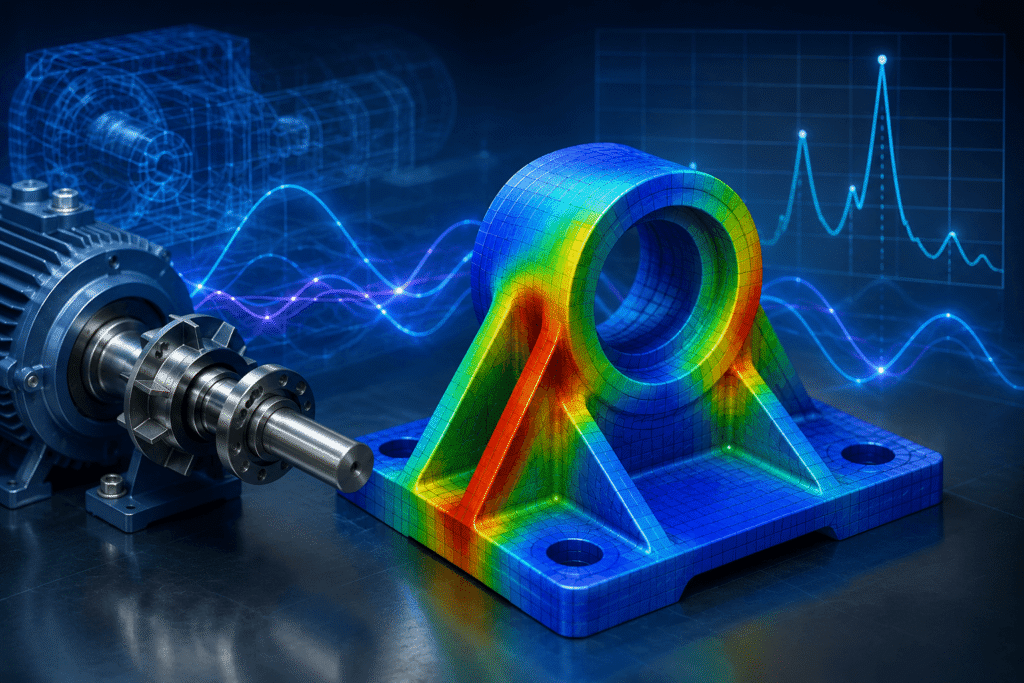
ANSYS Harmonic Analysis Services | SolidTrust
ANSYS Harmonic Analysis Services
Advanced Harmonic Response Simulation for Vibration and Dynamic Performance
SolidTrust provides professional ANSYS Harmonic Analysis services to evaluate the dynamic response of engineering components and structures subjected to periodic or sinusoidal excitation.
Harmonic analysis helps engineers understand how a component behaves across a specific frequency range by evaluating important parameters such as stress, displacement, acceleration, deformation, and frequency response.
Using ANSYS simulation, engineers can identify potential resonance conditions, evaluate vibration-related problems, and improve product reliability before moving to expensive physical prototype testing.
SolidTrust supports engineering simulation requirements across industries including automotive, aerospace, industrial equipment, energy, electronics, and mechanical engineering.
Get a Free Consultation
Request an ANSYS Harmonic Analysis Quote
What Is ANSYS Harmonic Analysis?
ANSYS Harmonic Analysis is a frequency-domain simulation method used to determine the steady-state response of a structure when it is subjected to sinusoidal or periodic loading.
Many engineering systems operate under continuously repeating forces. Motors rotate, pumps generate vibration, fans create periodic loads, and rotating machinery produces excitation at specific frequencies.
If the excitation frequency approaches a structure’s natural frequency, the resulting response can increase significantly. This can lead to excessive vibration, high stress, deformation, fatigue, noise, or even structural failure.
ANSYS Harmonic Analysis helps engineers study this behavior virtually and understand the response of a component across the required operating frequency range.
Why Harmonic Analysis Is Important in Engineering
Vibration is an important consideration in the design of mechanical and structural systems.
A component may perform correctly under static loading but experience significant problems when subjected to dynamic or repeating loads.
Harmonic analysis can help answer questions such as
- At which frequencies does the component experience high response?
- Where are the highest vibration levels occurring?
- What areas experience maximum dynamic stress?
- Is the structure approaching resonance?
- How much displacement occurs at different frequencies?
- Can the design withstand the expected operating conditions?
- What design modifications could reduce vibration?
By answering these questions during the design stage, engineers can make informed decisions before manufacturing and physical testing.
Our ANSYS Harmonic Analysis Services
Harmonic Response Simulation
We perform harmonic response simulations to evaluate structural behavior under periodic and sinusoidal excitation across a specified frequency range.
The analysis can help identify critical frequencies and areas experiencing significant dynamic response.
Frequency Response Analysis
Frequency response analysis evaluates how a structure responds as the excitation frequency changes.
Results can be used to understand changes in
- Displacement
- Stress
- Acceleration
- Velocity
- Structural response
- Dynamic deformation
Resonance Assessment
Resonance can create very high vibration amplitudes when excitation frequencies interact with the natural frequencies of a structure.
ANSYS simulation can help engineers identify potential resonance regions and assess their impact on structural performance.
Dynamic Stress Analysis
Harmonic loading can produce cyclic stresses within a component.
We analyze stress distribution across the structure to help identify areas that may require design improvement or additional investigation.
Vibration Displacement Analysis
The simulation can determine how much a component moves or deforms at different frequencies.
This is useful when excessive movement could affect component clearance, connections, performance, or reliability.
Engineering Design Optimization
Simulation results can be used to recommend design improvements.
Depending on the project, potential improvements may include changes to
- Geometry
- Material
- Thickness
- Stiffness
- Supports
- Mounting conditions
- Structural configuration
What Can ANSYS Harmonic Analysis Evaluate?
ANSYS Harmonic Analysis can provide valuable information about the dynamic performance of engineering components.
Stress
Identify areas experiencing high vibration-induced stress.
Displacement
Evaluate structural deformation at different excitation frequencies.
Acceleration
Understand the acceleration response of components subjected to harmonic excitation.
Frequency Response
Study structural response throughout the selected frequency range.
Natural Frequencies
Identify important natural frequencies through modal analysis and use them to understand potential dynamic interaction.
Resonance
Investigate frequencies where structural response may become significantly higher.
Mode Shapes
Understand how the structure deforms during different vibration modes.
Dynamic Structural Behavior
Evaluate the overall response of the component or assembly under periodic loading.
ANSYS Harmonic Analysis Workflow
Project Requirement Analysis
We first understand the engineering problem, operating environment, excitation source, frequency range, material information, and required simulation outputs.
CAD Model Preparation
The supplied CAD model is reviewed and prepared for finite element analysis.
Unnecessary geometric details may be simplified where appropriate to improve simulation efficiency without affecting important structural characteristics.
Material Definition
Appropriate material properties are assigned to the model based on the available engineering information.
Depending on the analysis requirement, properties may include
- Young’s modulus
- Poisson’s ratio
- Density
- Damping
- Yield strength
- Other relevant material properties
Meshing
The geometry is divided into finite elements to create the computational model.
Mesh quality and element size are considered based on geometry, loading conditions, expected response, and project requirements.
Boundary Conditions
Appropriate supports, constraints, contacts, and excitation conditions are defined.
The accuracy of the simulation depends significantly on how closely these conditions represent the real operating environment.
Modal Analysis
Modal analysis can be performed to determine natural frequencies and mode shapes.
This information is important when evaluating potential resonance and understanding the dynamic characteristics of the structure.
Harmonic Response Simulation
The harmonic response analysis is then performed over the required frequency range.
The model is subjected to the defined periodic excitation and the resulting structural response is calculated.
Results Evaluation
Simulation results are reviewed to identify
- Maximum stress
- Maximum displacement
- Critical frequencies
- Resonance regions
- High-response areas
- Dynamic deformation
- Other project-specific parameters
Engineering Recommendations
Based on the simulation results, recommendations can be provided to improve structural performance and reduce potential vibration-related risks.
Final Engineering Report
The final report can include simulation methodology, model information, boundary conditions, result plots, graphs, observations, and engineering recommendations.
Industries That Use ANSYS Harmonic Analysis
Automotive
Harmonic analysis can be used to evaluate vibration behavior in automotive components and mechanical systems.
Applications can include
- Engine components
- Chassis components
- Suspension systems
- Mounting systems
- Mechanical assemblies
- Rotating components
Aerospace
Aerospace components can experience vibration from engines, rotating equipment, and operational loads.
Harmonic analysis can help evaluate the dynamic response of structural and mechanical components.
Industrial Equipment
Industrial machinery frequently operates with rotating or reciprocating components.
Simulation can be used for
- Pumps
- Motors
- Fans
- Compressors
- Rotating machinery
- Industrial assemblies
Energy and Power
Power-generation equipment can be exposed to continuous dynamic loading and vibration.
Harmonic analysis can support the evaluation of turbines, generators, compressors, and related equipment.
Electronics
Electronic equipment and assemblies can be sensitive to vibration.
Simulation can help assess structural response and identify potential vibration-related design concerns.
Marine Engineering
Marine equipment and mechanical systems can experience vibration from engines, rotating machinery, and other sources.
Harmonic response simulation can support dynamic-performance evaluation.
Applications of ANSYS Harmonic Analysis
ANSYS Harmonic Analysis can be applied to many engineering problems involving periodic excitation.
Common applications include
- Rotating machinery
- Electric motors
- Pumps
- Fans
- Compressors
- Turbines
- Generators
- Automotive components
- Aerospace structures
- Industrial machinery
- Mechanical assemblies
- Electronic equipment
- Power-generation systems
- Structural components
ANSYS Harmonic Analysis and Resonance
One of the major reasons engineers perform harmonic analysis is to investigate resonance.
Every structure has natural frequencies at which it tends to vibrate.
When an external excitation frequency approaches one of these natural frequencies, the structural response can increase significantly.
This may result in
- Excessive vibration
- High dynamic stress
- Large displacement
- Noise
- Fatigue
- Component damage
- Reduced service life
A combination of modal analysis and harmonic response analysis can provide a better understanding of these dynamic characteristics.
Modal analysis identifies natural frequencies and mode shapes, while harmonic analysis evaluates how the structure responds to forced periodic excitation across a frequency range.
ANSYS Harmonic Analysis vs Modal Analysis
| Feature | Modal Analysis | Harmonic Analysis |
|---|---|---|
| Main objective | Determine natural frequencies and mode shapes | Determine response to periodic excitation |
| Analysis type | Dynamic characterization | Forced vibration response |
| Frequency | Natural frequencies | Selected frequency range |
| Stress response | Limited | Yes |
| Displacement response | Mode shapes | Frequency-dependent response |
| Resonance investigation | Identifies natural frequencies | Evaluates forced response near critical frequencies |
| Typical application | Understand structural dynamics | Evaluate vibration performance |
These two analyses are often complementary rather than alternatives.
Benefits of ANSYS Harmonic Analysis
Identify Critical Frequencies
Understand the frequencies at which a structure may experience increased dynamic response.
Detect Potential Resonance
Evaluate whether operating excitation frequencies may interact with structural natural frequencies.
Improve Structural Reliability
Identify high-stress and high-displacement areas that may affect component reliability.
Reduce Physical Prototype Iterations
Simulation can help identify potential problems before manufacturing physical prototypes.
Optimize Product Design
Use simulation results to make informed structural improvements.
Improve Vibration Performance
Understand how design changes affect the dynamic response of a component.
Support Engineering Decisions
Simulation results provide engineering data that can support design validation and development decisions.
ANSYS Harmonic Analysis Results
Depending on project requirements, the analysis can provide results such as
- Frequency response graphs
- Stress contours
- Displacement contours
- Acceleration results
- Natural frequencies
- Mode shapes
- Critical frequency identification
- Resonance observations
- Dynamic deformation
- Engineering recommendations
Graphs can be particularly useful for identifying frequencies where structural response increases significantly.
What Information Is Required for ANSYS Harmonic Analysis?
To begin a harmonic analysis project, the following information can be helpful
- CAD model
- Engineering drawings
- Material properties
- Component dimensions
- Operating conditions
- Excitation information
- Frequency range
- Load information
- Boundary conditions
- Mounting conditions
- Existing test data
- Required simulation outputs
If some information is unavailable, the engineering team can review the available project information and determine the appropriate analysis approach.
Why Choose SolidTrust for ANSYS Harmonic Analysis?
ANSYS-Based Engineering Simulation
SolidTrust provides engineering simulation services using ANSYS tools for a range of engineering applications.
Engineering-Focused Approach
The objective is not only to generate simulation results but also to understand the engineering problem and provide useful technical conclusions.
Industry Applications
Simulation capabilities can support automotive, aerospace, industrial, energy, electronics, and other engineering sectors.
End-to-End Support
Support can cover model preparation, simulation setup, analysis, results interpretation, optimization recommendations, and reporting.
Detailed Engineering Reports
Simulation reports can present important results through graphs, contour plots, observations, and engineering recommendations.
Frequently Asked Questions
What is ANSYS Harmonic Analysis?
ANSYS Harmonic Analysis is a frequency-domain simulation technique used to evaluate the steady-state response of a structure subjected to sinusoidal or periodic excitation.
What is harmonic response analysis used for?
It is used to study vibration, stress, displacement, acceleration, frequency response, and potential resonance behavior.
Can ANSYS Harmonic Analysis identify resonance?
Yes. Harmonic response analysis can evaluate structural response across a frequency range and help identify frequencies associated with significant dynamic response.
Is modal analysis required before harmonic analysis?
Modal analysis is not always mandatory, but it can be very useful for understanding natural frequencies and mode shapes and for identifying potential resonance conditions.
What industries can benefit from harmonic analysis?
Automotive, aerospace, industrial machinery, energy, electronics, marine, and other industries involving vibration-sensitive systems can benefit from harmonic analysis.
What types of loads can be studied?
Harmonic analysis can be used for periodic or sinusoidal excitation. The exact loading approach depends on the physical system and project requirements.
Can harmonic analysis help reduce vibration?
Yes. Simulation results can identify critical frequencies and high-response areas, helping engineers evaluate potential design modifications to reduce vibration.
Can SolidTrust provide an ANSYS Harmonic Analysis report?
Yes. A project report can include simulation methodology, model information, boundary conditions, frequency-response results, contour plots, observations, and engineering recommendations based on project requirements.
How can I start an ANSYS Harmonic Analysis project?
You can share the CAD model, operating conditions, excitation information, frequency range, and project objective with SolidTrust. The engineering team can review the requirements and recommend a suitable simulation approach.
Get ANSYS Harmonic Analysis Support
Are you facing a vibration, resonance, or dynamic-response problem with your engineering product?
SolidTrust can help evaluate your component or system using ANSYS Harmonic Analysis and provide simulation-based engineering insights.
Whether you need frequency-response evaluation, vibration analysis, resonance investigation, dynamic stress assessment, or engineering design recommendations, our team can support your simulation requirements.
