
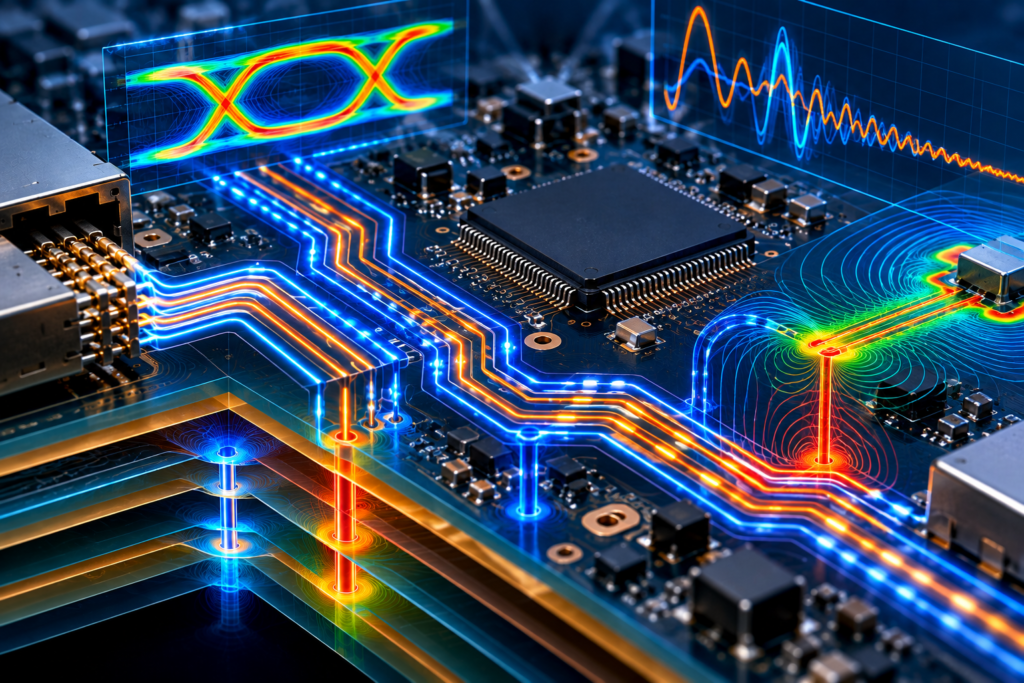
Signal Integrity Analysis Services Solid Trust
Signal Integrity Analysis Services, Modern electronic products depend on high-speed data transmission, compact PCB layouts, advanced IC packages, and reliable interconnects. As operating frequencies and data rates increase, engineers face challenges such as signal distortion, reflections, crosstalk, impedance mismatch, electromagnetic interference, and signal loss.
Signal Integrity Analysis Services help engineers identify and resolve these problems through advanced simulation before physical prototypes are manufactured. Simulation-based signal integrity analysis can improve PCB performance, reduce design iterations, and support the development of reliable high-speed electronic systems.
At SolidTrust, signal and power integrity analysis is supported through advanced ANSYS electronics simulation technologies, including ANSYS SIwave, HFSS, and Q3D Extractor, for PCB, package, interconnect, and high-frequency electromagnetic analysis.
What Is Signal Integrity Analysis?
Signal integrity analysis is the process of evaluating how electrical signals behave while travelling through PCB traces, vias, connectors, packages, transmission lines, and other interconnect structures.
In high-speed electronic designs, even small discontinuities can affect signal quality. Simulation helps engineers understand signal behavior and identify potential problems before they become expensive hardware issues.
Typical signal integrity problems include:
- Signal reflections
- Crosstalk
- Impedance mismatch
- Signal attenuation
- Propagation delay
- Noise
- Electromagnetic interference
- Via and connector discontinuities
- Transmission-line losses
By identifying these issues during the design stage, engineers can optimize PCB layouts and interconnect structures for reliable high-speed communication.
Why Are Signal Integrity Analysis Services Important?
As electronic systems become faster and more compact, maintaining clean and reliable signals becomes increasingly challenging.
A PCB may function correctly at low frequencies but experience significant signal-quality problems when operating at higher data rates. Signal integrity simulation allows engineers to evaluate these effects virtually.
Key benefits include:
1. Identify Signal Degradation
Simulation can help identify signal distortion, reflections, loss, and other factors affecting high-speed data transmission.
2. Reduce Crosstalk
Crosstalk can occur when signals travelling through nearby traces interact with each other. Signal integrity analysis helps engineers evaluate coupling effects and optimize PCB routing.
3. Optimize PCB Traces
Trace geometry, spacing, dielectric materials, layer structures, and routing can influence signal performance. Simulation helps engineers evaluate these design parameters.
4. Improve High-Speed Interconnect Performance
Connectors, vias, cables, packages, and transmission lines can introduce discontinuities and losses. These structures can be analyzed to improve overall signal performance.
5. Reduce Physical Prototyping
Simulation enables engineers to evaluate multiple design alternatives before manufacturing, helping reduce unnecessary prototype iterations and development costs.
SolidTrust’s electronics simulation capabilities include interconnect, connector, via, PCB, and package-level analysis for high-speed systems.
Signal Integrity Analysis Using ANSYS SIwave
ANSYS SIwave is specialized for signal integrity, power integrity, and electromagnetic analysis of PCBs, IC packages, and interconnects.
It can be used to evaluate high-speed PCB designs and investigate issues related to signal quality, crosstalk, power delivery, and electromagnetic interference.
PCB Signal Integrity Analysis
Signal integrity simulation can evaluate high-speed signals travelling through PCB traces and interconnect structures.
Engineers can investigate:
- PCB trace performance
- High-speed routing
- Signal reflections
- Crosstalk
- Differential pairs
- Via structures
- Transmission lines
- Interconnect behavior
Differential Pair Analysis
Differential signaling is widely used in high-speed communication systems. Maintaining appropriate spacing, impedance, and routing characteristics is important for reliable data transmission.
Simulation helps engineers analyze differential pairs and identify potential signal degradation.
Via and Trace Optimization
Vias and PCB traces can introduce electrical discontinuities, particularly in high-speed designs.
Simulation can help evaluate the effect of:
- Via geometry
- Trace width
- Trace spacing
- Layer transitions
- Return paths
- PCB stack-up
This allows engineers to optimize interconnect structures before manufacturing.
Signal Integrity and Power Integrity Analysis
Signal integrity and power integrity are closely related in modern electronic systems.
While signal integrity focuses on maintaining the quality of electrical signals, power integrity evaluates the stability and performance of power delivery networks.
ANSYS SIwave can be used for both SI and PI analysis, including power distribution network evaluation, noise analysis, and voltage stability assessment.
Important areas include:
- Power distribution network analysis
- PDN impedance
- Power noise
- Voltage fluctuations
- Decoupling capacitor optimization
- Grounding
- Signal and power interaction
A combined SI/PI approach can help engineers achieve more reliable high-speed PCB designs.
High-Speed Interconnect Analysis
High-speed systems contain many components that can influence signal quality.
These include:
- PCB traces
- Vias
- Connectors
- Cables
- Backplanes
- IC packages
- Chip-to-board connections
SolidTrust provides simulation capabilities for high-speed connectors, transmission lines, backplanes, packages, and interconnects using ANSYS electronics simulation technologies.
Simulation helps engineers understand how these structures affect signal loss, reflections, impedance, and crosstalk.
Q3D Extractor for Signal Integrity
ANSYS Q3D Extractor can be used to extract electrical parameters from complex 3D interconnect structures.
It calculates parameters such as:
- Resistance
- Inductance
- Capacitance
- Conductance
These extracted parameters can support circuit, signal integrity, and power integrity simulations.
Q3D analysis is particularly useful for:
- PCB interconnects
- Connectors
- IC packages
- Vias
- High-speed transmission structures
- Multi-layer PCB designs
Accurate parasitic extraction allows engineers to understand the electrical behavior of complex interconnect structures.
HFSS for High-Frequency Signal Integrity
ANSYS HFSS provides three-dimensional electromagnetic simulation for high-frequency electronic systems.
It can be used for PCB structures, connectors, antennas, RF components, and other electromagnetic applications. HFSS can also support high-fidelity signal integrity evaluation in high-speed circuits and systems.
HFSS is particularly useful when detailed three-dimensional electromagnetic behavior needs to be investigated.
Applications include:
- High-frequency PCB analysis
- Connector analysis
- RF structures
- Electromagnetic coupling
- EMI analysis
- High-speed interconnects
- Antenna and PCB interaction
EMI and EMC Analysis
Signal integrity problems can be closely associated with electromagnetic interference.
A high-speed PCB may generate or experience unwanted electromagnetic coupling that affects system performance.
Signal and electromagnetic simulations can help engineers identify potential EMI issues and develop design improvements.
SolidTrust’s ANSYS SIwave capabilities include EMI/EMC analysis, while HFSS can be used for detailed three-dimensional electromagnetic simulation.
Industries That Benefit from Signal Integrity Analysis
Signal Integrity Analysis Services are useful across several technology-driven industries.
Telecommunications
High-speed communication equipment requires reliable signal transmission and controlled electromagnetic behavior.
Automotive Electronics
Modern vehicles contain high-speed communication networks, sensors, control systems, infotainment systems, and advanced electronic modules.
Aerospace and Defense
Electronic systems used in aerospace and defense applications require reliable signal transmission and electromagnetic performance.
Data Centers and Servers
High-bandwidth server and data-center systems depend on high-speed interconnects and reliable power delivery.
Consumer Electronics
Smartphones, tablets, gaming systems, wearables, and other compact electronics require careful signal integrity design.
Industrial Electronics
Industrial control systems and high-speed electronic equipment can benefit from simulation-driven PCB and interconnect optimization.
SolidTrust identifies telecommunications, consumer electronics, automotive, aerospace, data centers, and other electronics applications among its simulation use cases.
Our Signal Integrity Analysis Services
At SolidTrust, signal integrity analysis can be integrated with broader electronics and electromagnetic simulation workflows.
Our capabilities can include:
- PCB signal integrity analysis
- High-speed PCB simulation
- Power integrity analysis
- Crosstalk analysis
- Differential pair analysis
- Transmission-line analysis
- Via analysis
- Connector simulation
- Interconnect analysis
- IC package analysis
- Parasitic extraction
- EMI/EMC analysis
- PDN analysis
- High-frequency electromagnetic simulation
Using ANSYS SIwave, HFSS, and Q3D Extractor, engineers can investigate electrical and electromagnetic behavior across PCB, package, and interconnect levels.
Signal Integrity Analysis Workflow
A typical simulation workflow may include:
Step 1 – Design Review
The PCB, package, interconnect, stack-up, material information, and relevant design requirements are reviewed.
Step 2 – Model Preparation
The required PCB or 3D electromagnetic model is prepared for simulation.
Step 3 – Material and Boundary Definition
Material properties, electrical parameters, ports, boundaries, and simulation conditions are defined.
Step 4 – Signal Integrity Simulation
The design is simulated to evaluate signal behavior and identify potential issues.
Step 5 – Results Evaluation
Engineers evaluate parameters such as signal quality, impedance, crosstalk, losses, electromagnetic coupling, and power integrity.
Step 6 – Design Optimization
Potential improvements to routing, trace geometry, vias, stack-up, connectors, grounding, and other structures can be evaluated.
Step 7 – Engineering Report
Simulation results, observations, plots, and design recommendations can be compiled into an engineering report.
Why Choose SolidTrust for Signal Integrity Analysis?
SolidTrust provides engineering simulation consulting using ANSYS electronics simulation technologies.
The company’s electronics simulation capabilities cover signal and power integrity, PCB and package analysis, electromagnetic simulation, and electronics thermal management.
Benefits of simulation-based engineering include:
- Early identification of design issues
- Reduced physical prototype iterations
- Improved high-speed signal performance
- Better PCB and interconnect design decisions
- Improved electromagnetic performance
- Faster design validation
- Engineering-focused simulation reports
Conclusion
High-speed electronic systems require careful control of signal behavior across PCBs, packages, connectors, vias, and interconnects. Signal Integrity Analysis Services provide engineers with a simulation-driven approach to identify signal degradation, crosstalk, impedance problems, electromagnetic coupling, and other high-speed design challenges.
With technologies such as ANSYS SIwave, HFSS, and Q3D Extractor, engineers can analyze and optimize PCB, package, and interconnect performance before physical prototyping.
If you are developing a high-speed PCB, electronic system, connector, IC package, or complex interconnect, professional signal integrity simulation can help improve reliability and reduce design risks.
Looking for Signal Integrity Analysis Services?
Contact SolidTrust Technologies for engineering simulation consulting and ANSYS-based electronics analysis.
Website: solidtrust.in
