
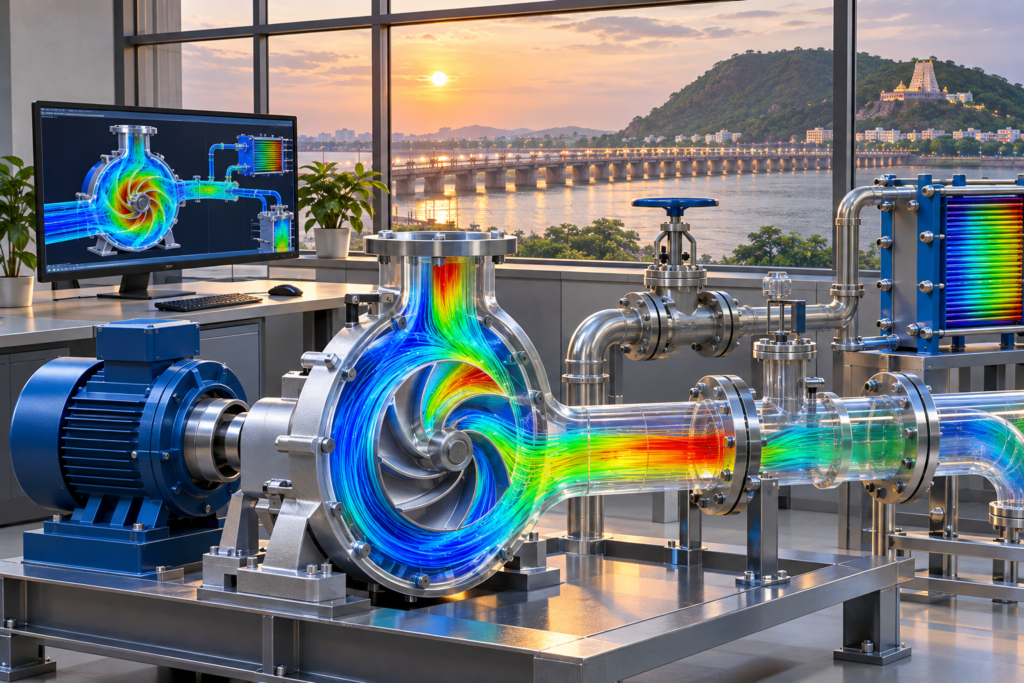
ANSYS Fluent Consulting ANSYS Fluent Consulting Vijayawada: Advanced CFD Simulation and Fluid Flow Analysis Services
ANSYS Fluent Consulting ANSYS Fluent Consulting Vijayawada: Advanced CFD Simulation and Fluid Flow Analysis Services Modern engineering products and industrial systems must operate efficiently under different flow, pressure, and temperature conditions. Whether it is a pump, cooling system, industrial machine, heat exchanger, or ventilation system, understanding fluid behaviour is essential for reliable product design and performance.
Computational Fluid Dynamics (CFD) simulation helps engineers study these conditions virtually, identify potential design problems, and evaluate different engineering solutions before manufacturing or physical testing.
SolidTrust Technologies provides engineering simulation support for businesses looking for ANSYS Fluent consulting in Vijayawada, offering CFD simulation, fluid flow analysis, thermal analysis, airflow simulation, and pressure distribution studies for various industrial applications.
What Is ANSYS Fluent and How Does It Help Engineering Companies?
ANSYS Fluent is a computational fluid dynamics software used to simulate liquid and gas flow, heat transfer, turbulence, and other complex fluid-related engineering phenomena.
It allows engineers to understand how fluids move through equipment, how pressure changes across different regions, and how temperature affects system performance.
With professional ANSYS Fluent consulting, engineering teams can investigate design challenges using simulation models rather than relying entirely on physical prototypes.
Typical simulation studies include:
- Internal and external fluid flow analysis
- Laminar and turbulent flow simulation
- Heat transfer and thermal analysis
- Pressure distribution and pressure drop evaluation
- Airflow and ventilation simulation
- Multiphase flow analysis
- Conjugate heat transfer analysis
- Flow optimization and design comparison
Why Is CFD Simulation Important for Industries in Vijayawada?
Vijayawada and its surrounding industrial areas have engineering and manufacturing activities involving machinery, industrial equipment, fluid systems, and process applications.
Companies developing these products may need to understand fluid movement, cooling performance, pressure losses, and thermal behaviour during the design stage.
CFD simulation can support these requirements by helping engineering teams:
- Evaluate fluid movement inside pipes, ducts, and equipment.
- Identify high-pressure and low-pressure regions.
- Study heat transfer and temperature distribution.
- Investigate unwanted turbulence and flow separation.
- Compare alternative product designs.
- Understand airflow and cooling performance.
- Identify potential engineering issues before production.
A properly planned simulation study provides useful technical information for design evaluation and engineering decision-making.
ANSYS Fluent Consulting Services in Vijayawada
SolidTrust supports different CFD simulation requirements depending on the project geometry, operating conditions, and engineering objectives.
1. Fluid Flow Simulation Services
Fluid flow simulation helps engineers understand how liquids and gases move through different components and systems.
This analysis can be applied to:
- Industrial pipelines and flow channels
- Pumps and fluid-handling equipment
- Valves and flow control systems
- Ducts and ventilation systems
- Process equipment
- Automotive fluid systems
Engineers can evaluate velocity distribution, pressure changes, flow patterns, and areas where flow behaviour may affect equipment performance.
2. Thermal CFD Analysis
Thermal CFD analysis is used to investigate heat transfer and temperature distribution in engineering systems.
It is useful for applications involving industrial cooling, electronic equipment, machinery, heat exchangers, and thermal management systems.
Simulation can help identify temperature hotspots, evaluate cooling effectiveness, and compare different thermal design configurations.
3. Airflow and Ventilation Simulation
Airflow simulation helps engineers understand how air moves around and through equipment, enclosures, rooms, and ventilation systems.
Common applications include:
- Industrial ventilation systems
- HVAC equipment
- Equipment cooling
- Air distribution systems
- Enclosure airflow
- Automotive cabin airflow
The results can help evaluate airflow distribution, identify stagnant regions, and investigate areas with insufficient cooling.
4. Pressure Drop and Pressure Distribution Analysis
Pressure drop analysis is important when evaluating the performance of fluid transportation systems.
CFD simulation can help study pressure losses across pipes, bends, valves, filters, and other components.
This information supports engineering decisions related to flow resistance, system configuration, and equipment design.
5. Turbulence and Flow Behaviour Analysis
Turbulence can influence pressure losses, heat transfer, mixing, and overall system performance.
ANSYS Fluent provides different turbulence modelling approaches that can be selected based on the flow conditions and simulation objectives.
Engineers can investigate flow separation, recirculation zones, turbulent regions, and other complex flow characteristics.
6. Conjugate Heat Transfer Simulation
Conjugate heat transfer analysis considers heat transfer between solid components and surrounding fluids.
It is particularly useful for cooling systems, industrial machinery, electronic enclosures, heat exchangers, and other applications where solid and fluid temperatures influence each other.
This analysis helps engineers evaluate thermal performance across interconnected solid and fluid regions.
Industries That Can Benefit from ANSYS Fluent Consulting
CFD simulation can support engineering teams across several industries in Vijayawada and Andhra Pradesh.
Automotive and Automotive Components
Analyze airflow, cooling systems, fluid movement, and thermal behaviour in automotive components and assemblies.
Manufacturing and Industrial Machinery
Evaluate fluid flow, cooling performance, pressure distribution, and thermal conditions in industrial equipment.
Pumps and Fluid Systems
Study internal flow behaviour, pressure distribution, velocity patterns, and flow-related performance challenges.
HVAC and Cooling Systems
Investigate airflow distribution, ventilation performance, heat transfer, and cooling effectiveness.
Energy and Power Applications
Evaluate fluid movement, heat transfer, and thermal performance in selected energy and power engineering systems.
Process and Chemical Engineering
Study flow distribution, mixing behaviour, pressure losses, and thermal conditions in process equipment.
Our ANSYS Fluent CFD Simulation Process
A structured simulation workflow is important for obtaining meaningful engineering results.
Step 1: Understand Project Requirements
The first step is to understand the engineering problem, simulation objectives, operating conditions, and expected results.
Step 2: Geometry Preparation
The CAD geometry is reviewed and prepared for CFD analysis. Unnecessary details may be simplified where appropriate to support efficient meshing and simulation.
Step 3: Mesh Generation
The computational domain is divided into smaller elements or cells. Mesh quality and refinement are considered based on geometry complexity and expected flow behaviour.
Step 4: Define Boundary Conditions
Relevant inlet, outlet, wall, thermal, material, and operating conditions are assigned according to the project requirements.
Step 5: CFD Solver Setup
Suitable physical models, solver settings, and numerical methods are selected for the simulation.
Step 6: Simulation and Convergence Review
The simulation is executed, and convergence behaviour and relevant solution monitors are reviewed to assess numerical stability.
Step 7: Results and Engineering Interpretation
Results can include velocity contours, pressure distribution, temperature contours, streamlines, and other relevant engineering outputs.
The results are interpreted against the original project objectives and available validation information.
Why Choose a CFD Consulting Company for Your Project?
Selecting the right CFD consulting team is important because simulation quality depends on more than software operation. Geometry preparation, mesh quality, physical model selection, boundary conditions, solver settings, and result interpretation all influence the usefulness of the analysis.
Before selecting a consulting provider, consider:
- Experience with similar engineering applications
- Understanding of fluid mechanics and heat transfer
- Appropriate mesh and solver methodology
- Clear simulation objectives and boundary conditions
- Technical reporting and result interpretation
- Ability to discuss design alternatives and engineering challenges
A reliable simulation workflow should explain the assumptions, limitations, and important findings rather than presenting only colourful simulation images.
Why Work with SolidTrust Technologies?
SolidTrust Technologies supports engineering simulation requirements for businesses and product development teams.
Our engineering simulation service areas include:
- Computational Fluid Dynamics (CFD) Analysis
- Finite Element Analysis (FEA)
- Structural Analysis
- Thermal Simulation
- Multiphysics Simulation
- Product Performance Analysis
- Engineering Design Evaluation
For companies searching for ANSYS Fluent consulting in Vijayawada, SolidTrust can discuss project requirements involving fluid flow, airflow, pressure distribution, heat transfer, and thermal performance.
Our approach focuses on understanding the engineering problem, selecting suitable simulation methods, and presenting results that support technical decision-making.
Frequently Asked Questions
1. What is ANSYS Fluent used for?
ANSYS Fluent is used for computational fluid dynamics simulations, including fluid flow, turbulence, heat transfer, airflow, pressure distribution, and multiphase flow analysis.
2. Can CFD simulation be used for industrial equipment?
Yes. CFD simulation can be used to investigate fluid movement, pressure losses, cooling performance, and heat transfer in industrial machinery, pumps, pipelines, and other equipment.
3. What information is required to start an ANSYS Fluent simulation?
Depending on the project, engineers may require CAD geometry, fluid and material properties, inlet and outlet conditions, operating temperatures, flow rates, pressure conditions, and the intended simulation objectives.
4. Can SolidTrust support companies in Vijayawada?
SolidTrust can discuss engineering simulation requirements from companies in Vijayawada and other locations in India. Project feasibility and scope depend on the technical requirements.
5. What results can be obtained from CFD analysis?
Typical results include velocity contours, pressure distribution, temperature contours, streamlines, flow patterns, turbulence information, and heat transfer results, depending on the simulation scope.
Conclusion: Get ANSYS Fluent Consulting Support in Vijayawada
CFD simulation is an important engineering tool for understanding fluid flow, pressure distribution, heat transfer, and thermal performance. It helps engineering teams investigate design challenges, compare alternatives, and make informed product development decisions.
If your business is looking for ANSYS Fluent consulting in Vijayawada, CFD simulation, fluid flow analysis, or thermal CFD analysis, connect with SolidTrust Technologies to discuss your engineering requirements.
Contact SolidTrust Technologies today:
