
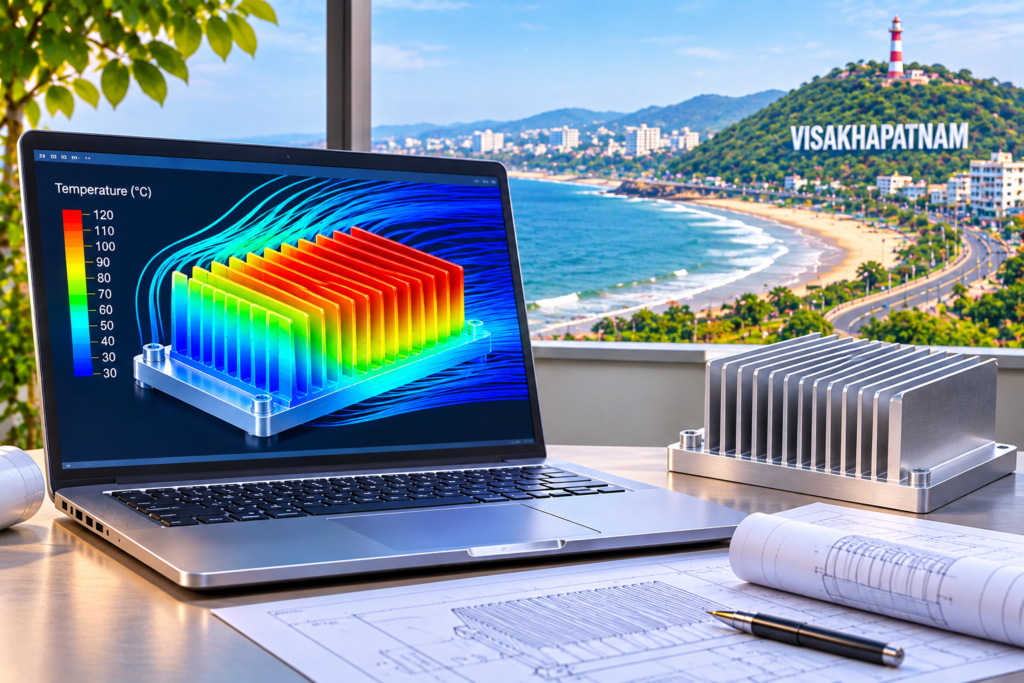
Thermal CFD Analysis Visakhapatnam – Industrial Cooling and Heat Transfer Simulation Services
Thermal CFD Analysis Visakhapatnam – Industrial Cooling and Heat Transfer Simulation Services Heat management is an important part of industrial equipment design. Excessive temperature can affect machinery, electronic components, cooling systems, and product performance. In many applications, the challenge is not simply removing heat. Engineers must also understand how heat moves through solid components and surrounding fluids.
This is where thermal CFD analysis in Visakhapatnam can help. Engineers use computational fluid dynamics to study temperature distribution, airflow, heat transfer, and cooling performance. The results help them understand thermal problems and evaluate possible design improvements.
SolidTrust Technologies supports engineering simulation requirements involving thermal analysis, fluid flow, heat transfer, and computational fluid dynamics.
What Is Thermal CFD Analysis?
Thermal CFD analysis combines fluid flow simulation with heat transfer calculations.
It helps engineers understand how temperature changes inside a system and how heat moves between different materials and fluids.
For example, consider an industrial machine that uses air or water for cooling. Thermal simulation can help examine whether the cooling medium reaches the required areas.
It can also reveal temperature differences across the equipment.
A thermal CFD study can investigate:
- Temperature distribution
- Heat transfer between solid and fluid regions
- Airflow and liquid cooling
- Thermal hotspots
- Cooling effectiveness
- Heat exchanger performance
- Conjugate heat transfer
- Temperature changes under different operating conditions
These results help engineers evaluate thermal behaviour before finalizing a design.
Why Do Industries in Visakhapatnam Need Thermal Simulation?
Visakhapatnam has important industrial activities involving steel, petroleum, pharmaceuticals, shipbuilding, power, and manufacturing.
Many of these industries operate equipment that generates or transfers heat. Therefore, understanding temperature distribution is important for equipment design and process evaluation.
Thermal CFD simulation can help investigate problems such as:
- Uneven cooling inside industrial equipment.
- High temperatures around components.
- Poor airflow in electrical enclosures.
- Heat transfer problems in industrial systems.
- Temperature variation across heat exchangers.
- Cooling performance under different operating conditions.
For example, an industrial enclosure may contain several heat-generating components. A thermal simulation can help engineers study airflow and temperature distribution inside the enclosure.
This information can support decisions about fan placement, ventilation openings, and cooling arrangements.
Thermal CFD Analysis Services Offered by SolidTrust
SolidTrust Technologies supports different thermal simulation applications based on project requirements and available design information.
1. Thermal Distribution Analysis
Temperature distribution analysis helps engineers identify how heat spreads across a component or system.
It can be useful for industrial machinery, electronic equipment, automotive components, and manufacturing applications.
Engineers can examine temperature gradients and locate regions that may require additional cooling.
2. Heat Transfer Simulation
Heat transfer simulation studies how thermal energy moves between different materials and surrounding fluids.
The analysis may involve conduction, convection, and radiation, depending on the application.
It can support the evaluation of industrial equipment, cooling systems, and thermal components.
3. Air Cooling Simulation
Air cooling is widely used in industrial equipment and electrical systems.
However, poor airflow can cause temperature buildup in certain regions.
CFD simulation helps engineers study airflow patterns, cooling distribution, and temperature variations.
It can also help compare alternative ventilation arrangements.
4. Liquid Cooling Simulation
Some industrial applications use water, oil, or other liquids to remove heat.
Thermal CFD analysis helps investigate fluid movement and heat transfer within these systems.
It can be useful for cooling channels, industrial machinery, and selected electronic cooling applications.
5. Heat Exchanger Analysis
Heat exchangers transfer thermal energy between fluids.
Their performance depends on flow distribution, temperature difference, pressure loss, and heat transfer conditions.
CFD analysis can help engineers examine these factors and investigate possible design improvements.
6. Conjugate Heat Transfer Analysis
Conjugate Heat Transfer (CHT) analysis studies heat transfer between solid materials and surrounding fluids.
For example, heat may move from a metal component into cooling air or liquid.
This analysis helps engineers evaluate the combined thermal behaviour of the solid and fluid regions.
7. Electronics and Electrical Equipment Cooling
Electronic components generate heat during operation.
If the cooling arrangement is inadequate, temperature may rise beyond the intended operating range.
Thermal CFD can help study:
- Airflow inside electronic enclosures
- Component temperature distribution
- Cooling fan performance
- Ventilation arrangements
- Heat transfer between components and air
The results can help engineers evaluate suitable thermal management solutions.
Industries That Can Benefit from Thermal CFD Analysis in Visakhapatnam
Steel and Metal Processing
Steel and metal processing applications involve high temperatures and heat transfer.
Thermal simulation can support suitable studies involving industrial equipment, cooling systems, and temperature distribution.
Petroleum and Chemical Industries
Process equipment may operate under demanding thermal conditions.
CFD can help investigate heat transfer, fluid movement, and temperature distribution in suitable applications.
Shipbuilding and Marine Engineering
Marine equipment may require thermal management for machinery, electrical systems, and cooling arrangements.
Simulation can help engineers study airflow and heat transfer.
Power Generation
Power-related equipment often involves thermal and fluid flow conditions.
CFD analysis can support selected cooling and heat transfer investigations.
Pharmaceutical Manufacturing
Temperature control is important in many pharmaceutical processes.
Thermal simulation may support suitable equipment and process engineering applications.
Industrial Manufacturing
Manufacturing equipment can generate heat during continuous operation.
Thermal CFD helps engineers investigate cooling performance and temperature variations.
Our Thermal CFD Simulation Workflow
A thermal simulation requires accurate project information and a suitable engineering methodology.
SolidTrust follows a structured approach to understand and evaluate the simulation requirements.
Step 1: Project Requirement Review
First, the engineering problem and expected results are discussed.
The review may include operating temperatures, cooling requirements, materials, and available CAD geometry.
Step 2: Geometry Preparation
The supplied CAD model is reviewed and prepared for simulation.
Unnecessary details may be simplified where appropriate.
Step 3: Mesh Generation
The computational domain is divided into smaller cells.
Additional refinement may be required around important thermal regions, walls, and narrow fluid passages.
Step 4: Material and Boundary Conditions
Material properties, fluid properties, heat sources, inlet conditions, outlet conditions, and wall conditions are defined.
Step 5: Solver Setup
Suitable heat transfer models and fluid flow settings are selected according to the engineering application.
Step 6: Simulation Execution
The thermal CFD simulation is executed.
Engineers review convergence behaviour and relevant solution monitors.
Step 7: Results Interpretation
The results are examined against the project objectives.
Typical outputs include:
- Temperature contours
- Heat flux distribution
- Airflow patterns
- Velocity contours
- Pressure distribution
- Thermal gradients
- Heat transfer results
The final interpretation considers the simulation assumptions and available validation information.
Why Choose SolidTrust Technologies?
Thermal simulation requires an understanding of both heat transfer and fluid behaviour.
SolidTrust Technologies supports engineering simulation requirements across several technical areas:
- Thermal CFD Analysis
- Computational Fluid Dynamics
- Fluid Flow Simulation
- Finite Element Analysis
- Structural Analysis
- Multiphysics Simulation
- Product Performance Analysis
- Engineering Design Evaluation
For businesses looking for thermal CFD analysis in Visakhapatnam, SolidTrust can discuss project requirements involving industrial cooling, airflow, temperature distribution, and heat transfer.
Each project can be evaluated according to its technical scope and available engineering information.
Frequently Asked Questions
1. What is thermal CFD analysis used for?
Thermal CFD analysis is used to study temperature distribution, fluid flow, cooling performance, and heat transfer in engineering systems.
2. Can thermal CFD identify overheating problems?
Yes. Simulation can help identify regions with high temperatures and investigate possible cooling limitations. Results depend on the quality of the model and input data.
3. Can airflow and thermal analysis be performed together?
Yes. Thermal CFD can combine airflow calculations with heat transfer analysis to study cooling performance.
4. What is conjugate heat transfer?
Conjugate heat transfer examines heat movement between solid materials and surrounding fluids within the same simulation.
5. Which software is used for thermal CFD simulation?
ANSYS Fluent is one commonly used platform for thermal and fluid flow simulation. The software and physical models should be selected according to project requirements.
6. What information is needed to begin a thermal simulation?
Typical inputs include CAD geometry, material properties, heat generation data, fluid properties, operating temperatures, and cooling conditions.
7. Does SolidTrust support thermal CFD projects in Visakhapatnam?
SolidTrust can discuss engineering simulation requirements from businesses in Visakhapatnam and other locations across India. The project scope depends on technical requirements and available information.
Contact SolidTrust for Thermal CFD Analysis in Visakhapatnam
Thermal performance affects the reliability and operation of many industrial systems. Understanding heat transfer and cooling behaviour can help engineers investigate problems and evaluate design alternatives.
If your company requires thermal CFD analysis in Visakhapatnam, industrial cooling simulation, airflow analysis, or heat transfer studies, contact SolidTrust Technologies.
SolidTrust Technologies – Engineering Simulation Services
